
Study: Conversational phone greetings shorten calls by 16%
One simple change can shorten customer service calls.
You don't need expensive new technology, extensive training, or an elaborate project. This change can be implemented immediately: answer the phone like a human.
A new study proves the impact of a great greeting. Over 370,000 calls were analyzed. Friendly, conversational-style greetings consistently drove shorter calls and happier customers.
This article shares an overview of the study, the tangible impact of a friendly greeting, and suggested actions to take advantage of this research.

About this phone greeting study
I partnered with AI solutions provider, QEval.ai, to conduct this study.
It used its AI-powered call evaluation technology to analyze 372,641 customer phone calls. The calls were spread over a wide variety of industries, companies, and call types. We tested three hypotheses:
Conversational greetings shorten calls
A friendly tone of voice shortens calls
Conversational greetings improve customer sentiment
The type of greeting customer service reps used to open each call was classified into one of three categories:
Conversational
These were simple, friendly greetings. Example: "Thank you for calling (company). This is Brianna. How may I help you?"
Verification
Agents opened calls with a request to verify the customer's account or identity. Example: "Thank you for calling (company). This is Robert. Can you verify your first name and date of birth?"
Corporate
These greetings were scripted nonsense, typically containing a brand tagline or overly flowery language. Example: "Thank you for calling (company). My name is Aisha. How can I delight you today?"
QEval.ai also evaluated the vocal pitch modulation each rep used to greet customers. Pitch modulation is the energy and variation used when speaking to convey emotion and interest. This allowed calls to be evaluated with a friendly tone (high pitch modulation) versus a robotic monotone (low pitch modulation). The tone was divided into four quartiles for simplicity, with Tier 1 being the lowest pitch modulation and Tier 4 being the highest pitch modulation.
Finally, these variables were compared to two results for each call: the duration and customer sentiment.
Customer sentiment was evaluated based on emotional content of the words the customer used throughout the call. This included their immediate response to the greeting and the customer's emotions at the end of the interaction.
This study builds on previous research about human service. This is customer service that uses uniquely human qualities to service customers. You can learn more from the book, Human Service: The Skills AI Can’t Replace.
Phone greeting study results
All three hypotheses were confirmed.
CONFIRMED: Conversational greetings shorten calls
CONFIRMED: A friendly tone of voice shortens calls
CONFIRMED: Conversational greetings improve customer sentiment
A conversational greeting, delivered with a friendly pitch, shortens customer service calls and improves sentiment. While the wording of a greeting is important, the study found that a friendly voice improves call results no matter what type of greeting is used.
Hypothesis 1: Conversational greetings shorten calls
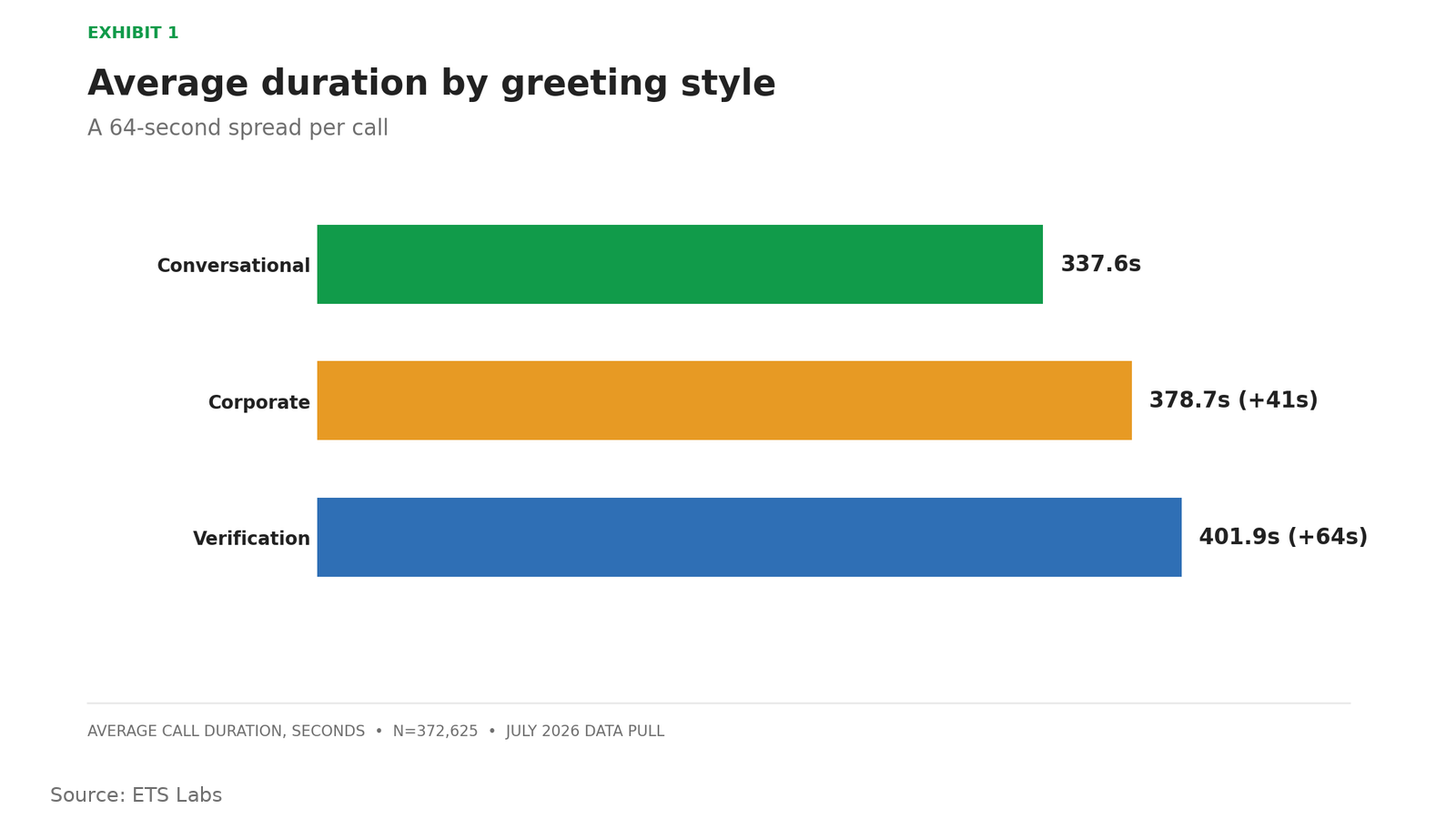
Calls that started with a conversational greeting averaged 16 percent shorter than verification-first greetings.
Listen to customer calls and you can hear why this happens. A conversational greeting immediately signals a partnership and invites customers to share their needs. Customers feel like they’re speaking with a real human who is there to help.
A verification-first greeting starts the call by asserting control. This can create an immediate conflict with customers who are eager to share their needs. While verification is often necessary, putting it at the start of the call creates a tug-o-war between the rep and the customer.
Corporate greetings are the least authentic of them all. They immediately put customers on guard. Surprisingly, they did lead to shorter calls than verification-first greetings.
Hypothesis 2: Friendly greetings shorten calls
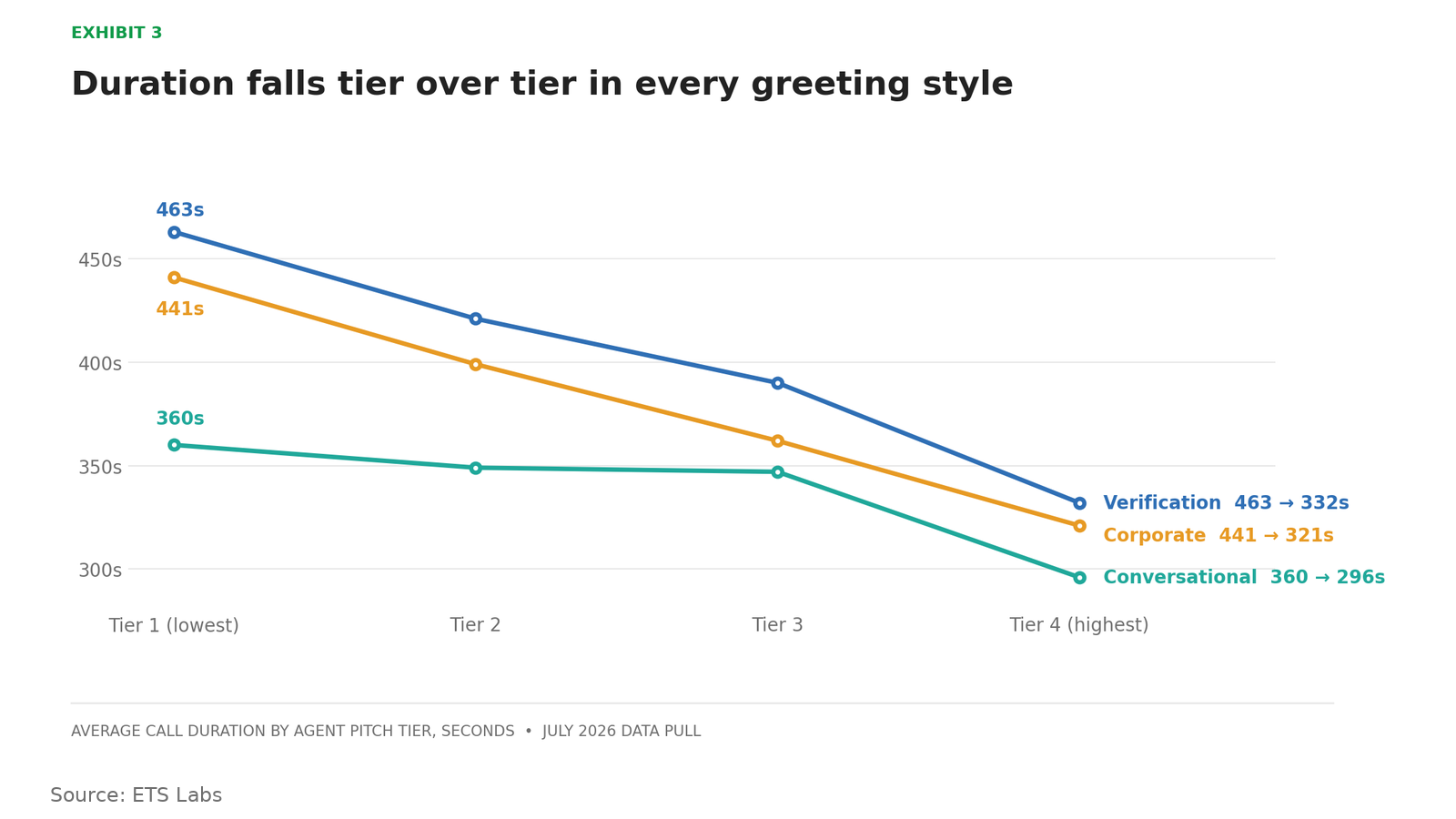
Answering the phone with higher pitch modulation shortens phone calls.
This held no matter what type of greeting is used. The chart below divides the pitch modulation into four quartiles for the sake of simplicity, with Tier 1 representing the lowest pitch modulation and Tier 4 reflecting the highest pitch modulation.
A warm tone of voice conveys friendliness. It primes the customer to expect a better outcome and makes it easier for customers to trust the contact center agent to help them with their needs.
A monotone voice conveys unfriendliness and disinterest. Customers keep their guard up when an agent answers the phone like an uncaring robot.
Hypothesis 3: Conversational greetings improve customer sentiment
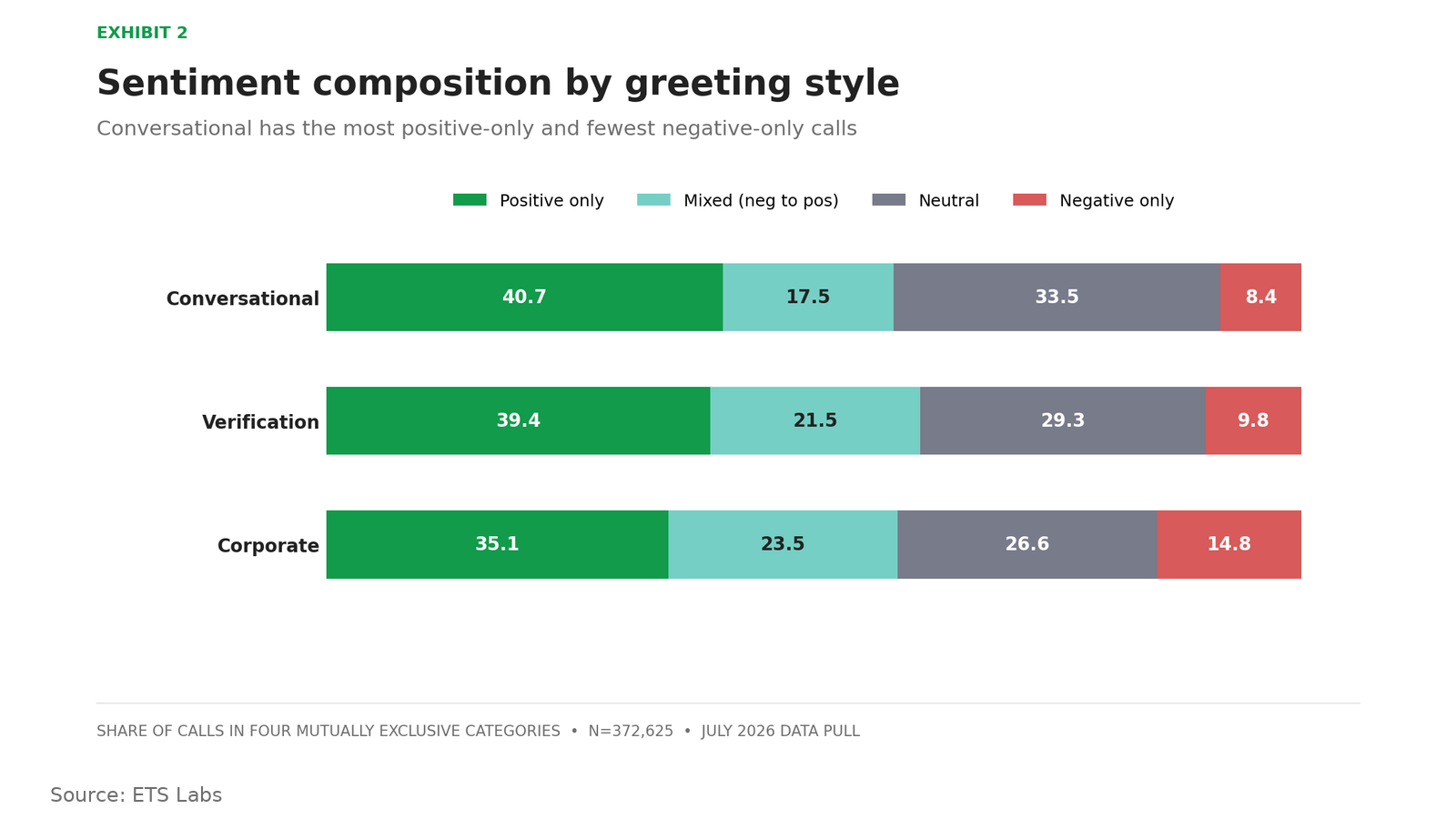
Answering the phone with a conversational greeting leads to happier customers when compared to other types of greetings The data showed a higher percentage of calls that were positive throughout when the call opened with a conversational greeting:
Conversational: 40.7% fully positive
Verification: 39.4% fully positive
Corporate: 35.1% fully positive
A conversational greeting also reduced the percentage of calls that started negative and remained negative throughout:
Conversational: 8.4% fully negative
Verification: 9.8% fully negative
Corporate: 14.8% fully negative
Corporate nonsense greetings were the worst-performers. This data suggests they should be banned from your contact center because no human actually talks like that.
This data data builds on two other studies of customer service greetings. One previous study showed friendly phone greetings improved first contact resolution by 12 percent. A study on in-person greetings demonstrated that human greetings got 69 percent of customers to smile compared to just 3 percent of customers who received a corporate-style greeting.
Suggested actions
Answering the phone like a human makes a tangible impact on call length and customer sentiment. Contact center leaders should emphasize the importance of good greetings with reps.
Wording: work with your team to adopt a conversational greeting.
Delivery: focus on using a warm, energetic tone to answer calls.
Warm, friendly greetings can become a habit with training, evaluation, and coaching.
You can help your team develop their perfect phone greeting with this short video. You can see a demonstration of a good phone greeting and then build your own. It’s part of the Phone-Based Customer Service course on LinkedIn Learning.
